
Chatham County Court Records After Arrest
A jail arrest starts the custody side of the matter. The court side begins when the case is opened, charges are filed, hearing dates are set, or the prosecutor takes action. In Chatham County, that path runs through the North Carolina Judicial Branch, the Chatham County Clerk of Superior Court, magistrates, and the District Attorney for Prosecutorial District 18, which covers Chatham and Orange Counties.
The sheriff roster can show a booking charge and bond amount. The court record may later show a different charge, an amended charge, a dismissal, an indictment, a plea, or a sentence. For the custody side, use Chatham County jail inmate records. For booking photos, use Chatham County jail mugshots. For formal charges and case status, use the court channels below.
Search Chatham County Court Records
The main online channel is the North Carolina eCourts Portal. The Judicial Branch describes Portal as a service for court information, smart searches, hearing dates, case information, and payments. The Chatham County Judicial Branch location hub is the local starting point for courthouse services, court dates, forms, and contact routing. For copies, older files, certified records, and criminal background-check guidance, contact the Chatham County Clerk of Superior Court rather than relying only on a portal screen.
- Open the eCourts Portal and select a case search or smart search option.
- Search by defendant name, case number, citation number, or other indexed text when available.
- Filter to Chatham County or the proper case category if statewide results are too broad.
- Open the case entry and compare the filed court charges with the earlier booking charge.
- Check hearing dates, disposition text, payment links, and charge status, then confirm official copies with the Clerk.
The eCourts Portal is the official search interface for many North Carolina case records.
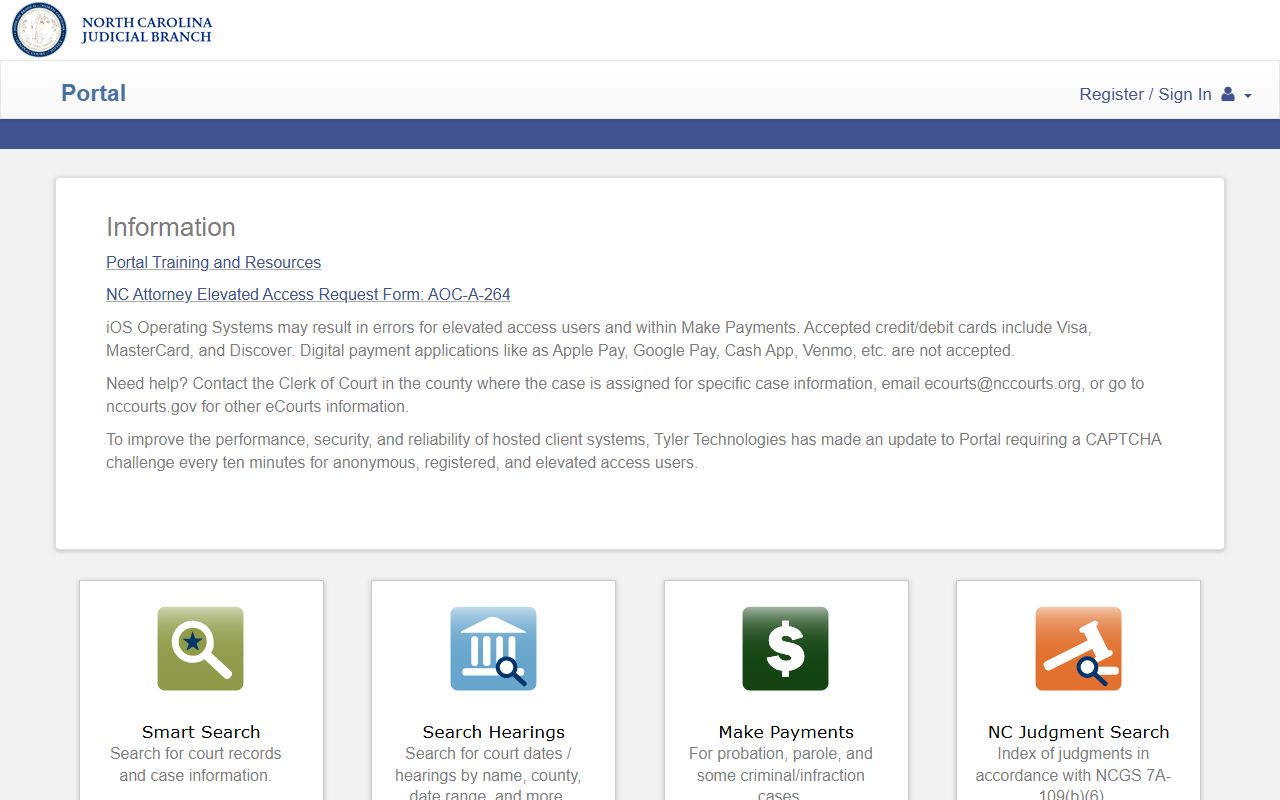
The portal image is useful because Chatham County court records after a jail arrest are searched by court case data, not by jail roster cards.
Chatham County Court Search Fields
Portal fields can vary by mode, but the research captured the practical fields a Chatham County user should expect. Use exact identifiers when possible. Name searches can return broad results, especially for common surnames.
| Field Label | Type | Required | Notes |
|---|---|---|---|
| Smart Search / Search | Text | Optional | Can search party name, case number, citation number, or indexed record text depending on mode. |
| Name | Text | Optional | Search defendant name; try variants and middle initials. |
| Case Number | Text | Optional | Best exact match when known from a citation, warrant, or court notice. |
| Citation Number | Text | Optional | Useful for traffic and criminal citation records. |
| County / Location | Dropdown or filter | Optional | Select Chatham County when statewide results are broad. |
| Case Type | Filter | Optional | May include criminal, infraction, civil, and other categories depending on portal view. |
Arrest to Court Record
The custody path and the court path overlap, but they are not the same record. Law enforcement books the person into the Chatham County Detention Center. A magistrate or court official handles release conditions and bond. The District Attorney then reviews the allegations and decides how to proceed. The clerk and court system create or update the case record with charges, dates, and docket entries.
That sequence explains why Chatham County court records after an arrest may not match the first jail listing. Booking charges can be amended, reduced, dismissed, superseded by indictment, or replaced by formal court charges. A disposition is the result of a charge or case, such as guilty, dismissed, not guilty, deferred, probation, sentence, or other final action.
Process: Arrest and booking > magistrate or initial appearance > prosecutor review > court case creation > hearing dates > disposition.
Chatham County Charging Documents
A charging document is the paper or electronic court filing that states the accusation. North Carolina case records may use labels and procedures that vary by charge level and case stage. The key point is practical: the filed court charge is what drives the court case, while the jail booking charge is the custody entry made at intake.
| Document Type | Who Uses It | What It Means |
|---|---|---|
| Complaint or warrant-based charge | Officer, magistrate, or court process | Often starts the case after probable cause and arrest processing. |
| Information | Prosecutor | Formal prosecutor-filed charge in matters where that procedure applies. |
| Indictment | Grand jury | Formal felony accusation after grand-jury action. |
Chatham County Charge Status
Charge status is the court record's snapshot of what is happening with an accusation. It should not be read as a conviction unless the case actually shows a conviction or guilty disposition. If the language is unclear, ask the Clerk of Superior Court for official copies or procedural guidance.
| Status | What It Means |
|---|---|
| Pending | The charge has been filed but has not reached final disposition. |
| Amended | The charge text, level, or theory changed from an earlier version. |
| Reduced | The charge was lowered to a lesser offense. |
| Dismissed | The charge ended without conviction. |
| Nolle prosequi style disposition | The prosecutor does not proceed, with the exact label controlled by the court record. |
| Conviction | The court record reflects guilt by plea, verdict, or other adjudication. |
Bond After Chatham County Arrest
The sheriff's bond page defines bond as a monetary guarantee that a defendant will appear in court while the case is pending. The Chatham materials focus on secured bond options: paying the full cash amount, using a bail bondsman, or using real property. A bond amount on a jail profile does not prove release is available, because a hold, detainer, no-bond order, or another agency request can block release.
| Release Path | Chatham County Detail |
|---|---|
| Full cash secured bond | The sheriff page says the full amount is paid in cash to the magistrate and can be returned after case disposition if court appearances are complete. |
| Bail bondsman or surety | A bondsman may charge up to 15% of the bond amount, and that fee is non-refundable. |
| Property bond | Real property can be used after Register of Deeds and Clerk of Court steps. |
| No-bond or hold | A court order, detainer, probation/parole hold, federal hold, or ICE hold can prevent local release. |
Warrants and Court Records
The Chatham sheriff site has an Arrest Blotter and a Most Wanted page, but no confirmed public active-warrant search table was found in the inspected sources. Warrant questions should be routed through official channels: Sheriff's Office main phone 919-542-2811, Detention Center 919-545-7802 for current custody, magistrates at 919-545-3519 during business hours or 919-542-2911 after hours, and the Clerk at 919-545-3500 for case records.
An arrest warrant, bench warrant, or order for arrest can lead to a booking record at the detention center. A search warrant is different. It authorizes a search and may not mean the person is in custody. For court records after a jail arrest, the warrant may explain why the person was booked, while the case record shows what charge or court action followed.
Charges, Convictions, Sealed Records
Several terms look similar in public searches but have different legal meaning. Treat an arrest as an allegation and custody event. Treat a charge as a filed accusation. Treat a conviction as a final adjudication of guilt. Sealing and expunction questions should be checked through North Carolina Judicial Branch expunction resources and the Chatham court office.
| Comparison | First Item | Second Item |
|---|---|---|
| Charge vs. conviction | A charge is an accusation in the case record. | A conviction is a final guilty result by plea, verdict, or adjudication. |
| Booking charge vs. court charge | Booking charge appears on the jail record. | Court charge is the prosecutor and court-filed case entry. |
| Sealed vs. expunged | Sealed records are hidden from ordinary public access. | Expunction is a court process that removes eligible records under state rules. |
Note: A dismissed charge can still require a court process before public access changes in downstream records.
Chatham County Record Access
North Carolina public-records law is broad, but it has limits. G.S. 132-1 defines public records for state and local agencies. G.S. 132-6 provides the inspection and copy rule for non-exempt public records. G.S. 132-1.4 limits criminal-investigation and criminal-intelligence records, which can affect incident materials and law-enforcement photographs.
For court documents, use the Clerk of Superior Court. For sheriff reports or jail records, use the sheriff public-records form. For prison records, use NCDAC. Chatham County's own public-records routing page tells requesters not to send court-document requests to the sheriff, and it lists the Clerk as the court-record contact.
Chatham County Court Contacts
The Chatham County Courthouse is the local center for court records after a jail arrest. The District Attorney is Jeffrey Nieman for Prosecutorial District 18, and the Chatham court contact directory lists the DA phone as 919-545-3510. The DA's role is prosecution, victim advocacy, and case decision-making, not general custody confirmation.
Chatham County Courthouse
40 E Chatham Street
Pittsboro, NC 27312
919-545-3500
Monday-Friday, 8:30 a.m.-5:00 p.m.
District Attorney, District 18
Chatham and Orange Counties
Chatham County court location in Pittsboro
919-545-3510
Prosecution and victim-services routing for filed criminal cases.